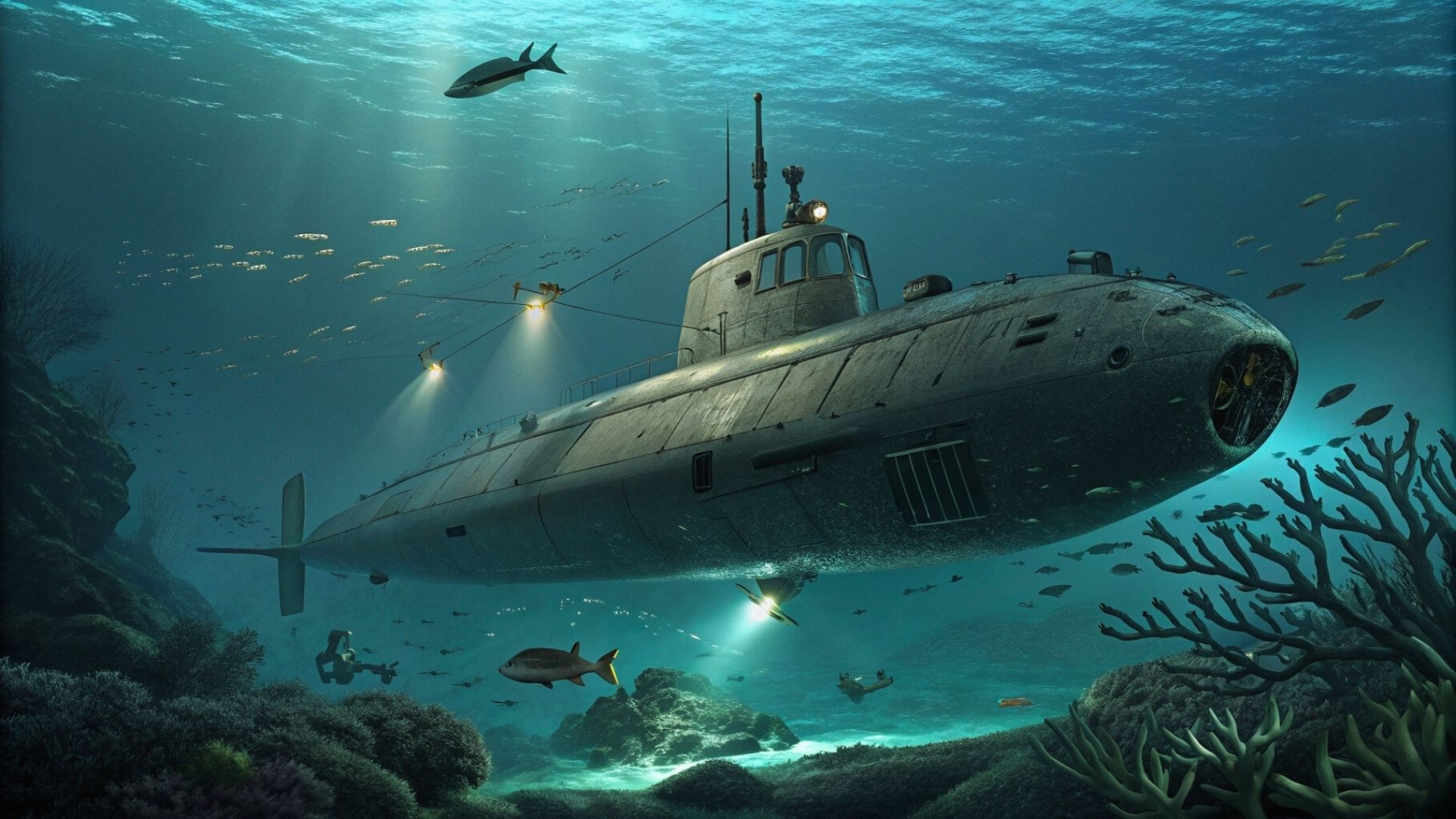

A submarine does not always need superior speed to gain an advantage. In many undersea operations, the ability to remain undetected can be far more valuable. This principle is central to the Type 212CD submarine, a next-generation conventional submarine designed around stealth, endurance and survivability.
Developed for Germany and Norway, the Type 212CD represents a major evolution of the proven Type 212A design. With a larger hull, distinctive diamond-shaped outer geometry, advanced acoustic stealth, air-independent propulsion (AIP) and modern combat systems, the submarine is designed to perform intelligence, surveillance, anti-submarine warfare, anti-surface warfare and special operations missions.
Optimised for the Baltic Sea, North Atlantic and Arctic environments, the Type 212CD is expected to play an important role in strengthening NATO’s undersea surveillance and maritime-defence capabilities in northern Europe.
A Look at the Type 212CD
The Type 212CD, or Common Design, is a diesel-electric attack submarine jointly developed by thyssenkrupp Marine Systems (TKMS) and the Norwegian Defence Materiel Agency for the German and Royal Norwegian navies.
Although it is based on the Type 212A, the Type 212CD is considerably more than a conventional upgrade. Its larger hull accommodates enhanced sensors, improved endurance and a modern combat-management architecture. Its distinctive external geometry is also designed to reduce radar visibility when surfaced, while extensive acoustic-signature reduction measures improve its underwater stealth.
The submarine is intended to counter increasingly sophisticated undersea threats while providing NATO with an effective platform for surveillance, deterrence and maritime security across strategically important northern waters.
Origins and Development
The Type 212CD builds on the Type 212A, one of Europe’s most advanced conventional submarine designs. Developed by TKMS and introduced into German Navy service in 2005, the Type 212A was among the first operational submarines to use hydrogen fuel-cell AIP as a core propulsion capability.
The technology enabled the submarine to remain submerged for extended periods with extremely low acoustic emissions, providing a major advantage over conventional diesel-electric submarines that require regular snorkeling to recharge their batteries.
As the maritime security environment evolved, however, the original Type 212A architecture faced limitations in terms of hull volume, sensors and combat-system growth potential. Increasing submarine activity in the North Atlantic and Baltic region also created new operational requirements.
The Type 212CD was therefore conceived to preserve the strengths of the Type 212A while significantly expanding its capabilities. The new design incorporates a larger hull, advanced sensors, a modern combat-management system and additional signature-reduction technologies.
Germany and Norway have also adopted a common-development approach covering logistics, maintenance, training and future upgrades.
Major Programme Milestones
2017: Germany and Norway agreed to jointly develop the Type 212CD based on the Type 212A.
2021: TKMS received the initial production contract for six submarines—two for Germany and four for Norway.
2023: Construction of the lead submarines officially began at TKMS’s shipyard in Kiel, Germany.
2024–2025: Germany placed additional orders, expanding its planned Type 212CD fleet to six submarines.
2026: Norway approved two additional submarines, increasing its planned fleet to six.
2026: Canada identified the Type 212CD as the design for its future Canadian Patrol Submarine Project.
2029: The first Type 212CD is planned to enter Royal Norwegian Navy service, with German deliveries expected to follow in the early 2030s.
How the Type 212CD Works
Air-Independent Propulsion
A major advantage of the Type 212CD is its hydrogen fuel-cell AIP system. Conventional diesel-electric submarines must periodically snorkel to recharge their batteries, potentially exposing themselves to detection.
AIP reduces this requirement by allowing the submarine to remain submerged for weeks while generating very low acoustic emissions. This makes the platform particularly suitable for covert surveillance, intelligence gathering and prolonged operations in contested waters.
Diamond-Shaped Outer Hull
The Type 212CD’s most visually distinctive characteristic is its angular, diamond-shaped outer hull. Instead of the conventional rounded submarine profile, the faceted geometry is designed to scatter radar energy when the submarine is operating near the surface.
Combined with a carefully shaped sail and low-signature external fittings, the design helps reduce the submarine’s overall observability.
Advanced Sensor Suite
The submarine incorporates an advanced sensor architecture comprising sonar systems, optronic masts, electronic-support measures and an integrated combat-management system.
Sensor data can be combined into a unified tactical picture, helping crews detect and classify submarines, surface vessels and other contacts while improving situational awareness and coordination with allied forces.
Enhanced Acoustic Stealth
Stealth is fundamental to the Type 212CD design. In addition to its quiet AIP system, the submarine uses raft-mounted machinery, vibration-isolation technologies and acoustic treatments to reduce underwater noise.
These measures are intended to make the submarine more difficult for passive sonar systems to detect, improving survivability during surveillance and combat missions.
Common Design Approach
Germany and Norway opted for a common submarine architecture rather than developing separate classes. Operating largely similar vessels allows both navies to share training systems, maintenance procedures, spare parts, software upgrades and logistical infrastructure.
This approach can reduce life-cycle costs while improving interoperability between the two fleets.
Strengths
The Type 212CD offers several important advantages. Its hydrogen fuel-cell AIP system provides extended submerged endurance, while its acoustic and external signature-reduction technologies enhance survivability.
Its integrated sensors and combat systems support complex undersea missions, while the common German-Norwegian design can reduce long-term logistical and maintenance costs. The submarine is also specifically tailored for operations in the Baltic Sea, North Atlantic and Arctic environments.
Limitations
Despite its advanced capabilities, the Type 212CD remains a conventional submarine and therefore cannot match the sustained high-speed endurance of nuclear-powered submarines.
Its advanced propulsion, stealth and combat systems also contribute to higher procurement costs compared with earlier conventional submarines. Furthermore, the development of an entirely new submarine class has introduced programme complexity and schedule challenges.
Its operational design is also particularly suited to northern European and littoral environments rather than unrestricted global deployment.
Operators and Strategic Role
The Type 212CD has not yet entered operational service, with the first delivery planned for 2029. Germany and Norway are acquiring the submarine to replace ageing platforms and maintain a strong undersea presence in the Baltic Sea, North Atlantic and Arctic.
The class is expected to contribute to NATO’s efforts to monitor maritime activity, protect critical sea lines of communication and strengthen deterrence in northern European waters.
The design has also attracted interest beyond its initial operators. Canada has selected the Type 212CD as the design for its future Canadian Patrol Submarine Project, intended to replace the Royal Canadian Navy’s Victoria-class submarines.
Future Outlook
The Type 212CD programme extends beyond the construction of a new submarine class. Germany and Norway are building a shared ecosystem covering logistics, training, maintenance and future capability development.
Future upgrades could include greater integration of unmanned underwater vehicles, improved electronic-warfare capabilities, enhanced digital networking and further reductions in acoustic signatures.
As undersea warfare becomes increasingly dependent on stealth, sensors, networking and persistent surveillance, the Type 212CD is positioned to become an important component of European conventional submarine operations.