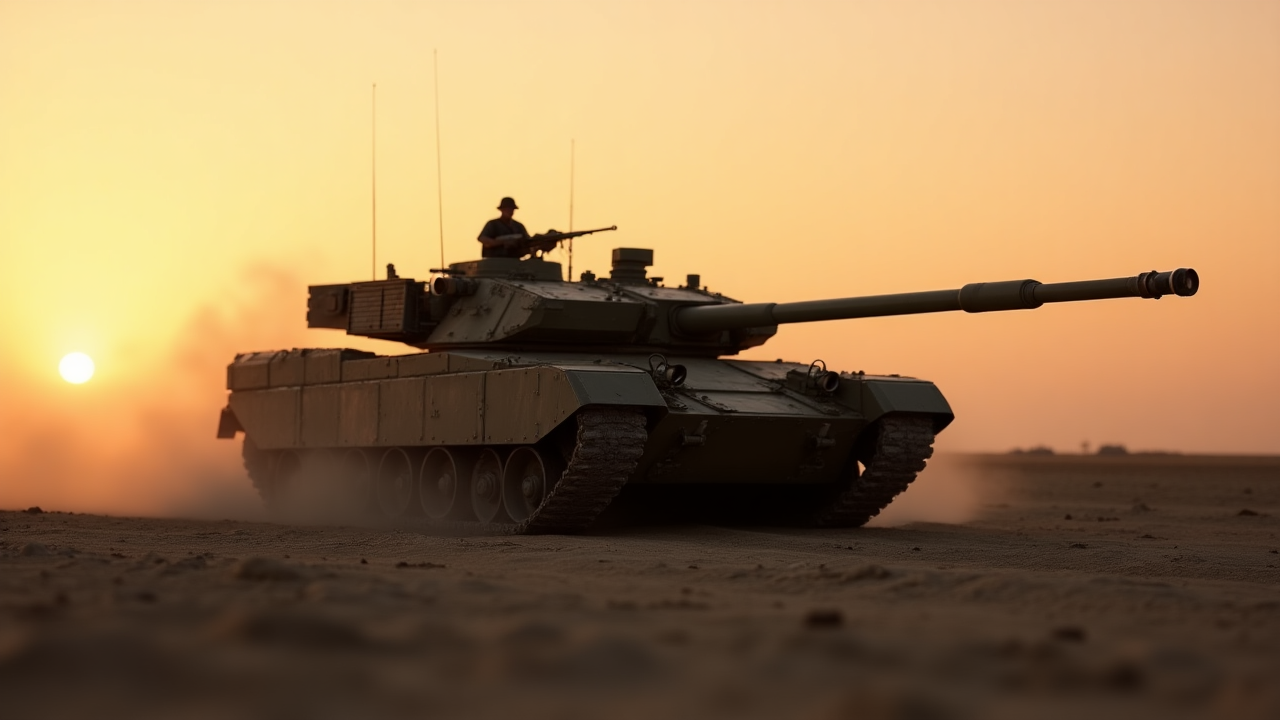
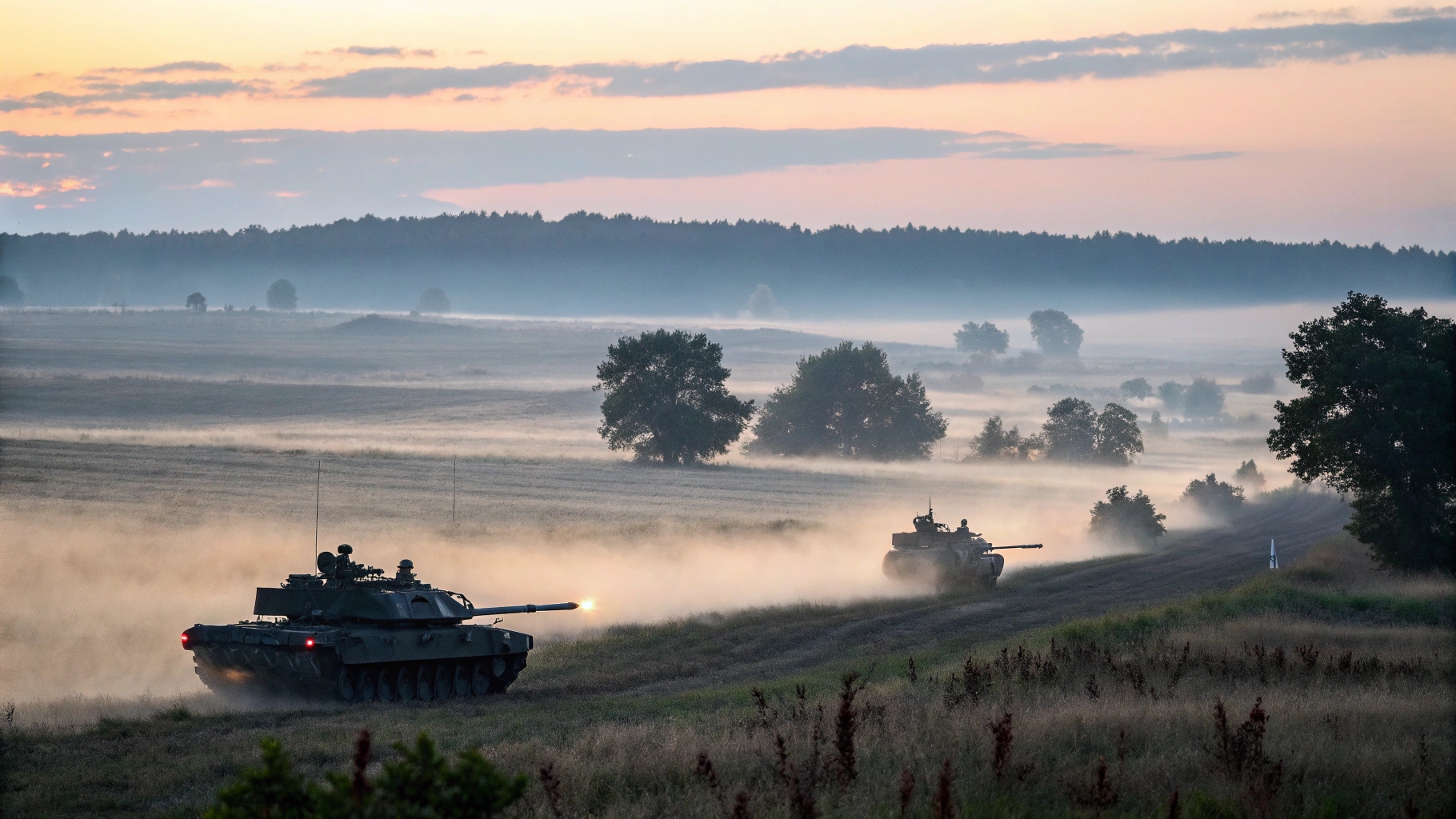
The Soviet Union may have vanished more than 30 years ago, but its armored engineering legacy remains visible on modern battlefields. The T-90 is a prime example. Rather than replacing the T-72 with an entirely new tank, Russian designers developed an improved successor that retained the established platform’s core characteristics while adding stronger protection, improved fire-control technology, and enhanced mobility.
The result has been a main battle tank that has remained relevant through decades of upgrades and has become a central component of Russia’s armored forces as well as a major export product.
What Is the T-90?
The T-90 is a third-generation Russian main battle tank developed at the state-owned Uralvagonzavod under chief designer Vladimir Potkin.
The vehicle entered service in the early 1990s as Russia sought a modern standardized tank capable of replacing older Soviet-era platforms without undertaking the cost and complexity of a completely new design.
The development strategy emphasized incremental improvement. Engineers concentrated on survivability, firepower, target engagement, reliability, and mobility while retaining many of the logistical advantages associated with Soviet tank designs.
This evolutionary approach produced a vehicle suited to armored assaults, mechanized operations, and engagement of enemy targets across diverse environments. Continued modernization has since transformed the T-90 from a post-Cold War tank into one of Russia’s principal armored platforms and a prominent defense export.
The T-90 Family
The T-90 has developed into a large family of main battle tanks and specialized support vehicles over its more than 30 years of service.
Although the variants share a common design foundation, successive models have introduced improvements in armor protection, weapon systems, electronics, mobility, communications, and specialized mission capabilities.
Main Variants
T-90 (Object 188): The first production model entered Russian service in 1992. It was equipped with a 125mm smoothbore gun, Kontakt-5 explosive reactive armor, and the Shtora-1 electro-optical countermeasure system.
T-90K: Designed for command roles, this variant adds enhanced radios, navigation equipment, and command-and-control capabilities while preserving the baseline tank’s combat functions.
T-90S: Developed as an export version, the T-90S has been delivered to India, Algeria, Azerbaijan, Iraq, Turkmenistan, Uganda, and Vietnam. Its configuration could be modified to satisfy individual customer requirements.
T-90SK: This export command variant of the T-90S incorporates improved communication and navigation equipment to support command units.
T-90A: The T-90A introduced several major improvements during the early 2000s, including a welded turret, a 1,000-horsepower engine, thermal imaging equipment, and upgraded fire-control systems.
T-90SA: This export derivative of the T-90A retained many of the model’s improvements while being adapted for foreign customers.
T-90MS: First unveiled in 2011, the T-90MS represents a substantially modernized export configuration. It features a redesigned turret, advanced fire control, digital battlefield management, improved armor, enhanced crew ergonomics, and increased engine power.
T-90M “Proryv” (Object 188M): The T-90M represents Russia’s most advanced operational T-90 configuration. Its improvements include Relikt explosive reactive armor, an upgraded 125mm 2A46M-5 cannon, digital fire-control equipment, panoramic commander sights, enhanced communications, and additional crew protection.
Specialized Support Vehicles
The T-90 platform has also served as the foundation for support vehicles designed to operate alongside armored formations.
BREM-1M: This armored recovery vehicle is intended to recover disabled or damaged tanks and conduct repairs in combat environments. Its equipment includes a recovery winch, crane, bulldozer blade, and repair systems.
IMR-2MA: The IMR-2MA supports combat engineering operations by clearing obstacles, removing debris, preparing routes, and assisting armored formations. It carries a hydraulic crane, dozer blade, and specialized engineering equipment.
MTU-90: This armored bridge-layer enables military units to overcome rivers, trenches, and other obstacles by rapidly deploying bridges for tanks and other heavy vehicles.
How Does the T-90 Work?
The T-90 combines a powerful main armament, layered protection, and a compact vehicle configuration to deliver mobility and combat capability.
Key Features
125mm Gun With Guided Missile Capability
At the heart of the T-90’s firepower is a 125mm smoothbore cannon operated through an automatic loading mechanism. The system allows the tank to function with a three-member crew because a separate human loader is not required.
The cannon can fire conventional armor-piercing and high-explosive rounds and can also launch 9M119 Refleks, known by the NATO designation AT-11 Sniper. These laser-guided anti-tank missiles provide an extended engagement capability against armored targets and low-flying helicopters.
Layered Survivability
The T-90 uses several defensive measures to increase battlefield survivability. Depending on the model, these include composite armor, Kontakt-5 or Relikt explosive reactive armor, smoke grenade launchers, laser warning receivers, and the Shtora-1 electro-optical countermeasure system.
On the T-90M, additional protection comes from a redesigned turret, stronger side protection, spall liners, and improved ammunition storage intended to enhance crew protection.
Compact Design for High Mobility
The T-90 maintains the compact profile associated with Soviet tank development. Its automatic loader reduces the crew requirement to three and contributes to a smaller turret configuration.
Engine output has evolved considerably across the family, from approximately 840 horsepower on the original T-90 to roughly 1,130 horsepower on the T-90M. This combination supports cross-country mobility while helping maintain relatively manageable transportation and maintenance requirements.
Strengths
Cost-effective modernization: The T-90 benefits from an evolutionary development strategy that allows new technologies to be introduced without completely redesigning the platform.
Compact and logistically efficient: Its comparatively compact dimensions and lower combat weight can make transportation, recovery, and maintenance less demanding than for heavier Western tanks.
Proven export platform: The tank has achieved extensive international adoption across Asia, Africa, and the Middle East. Licensed production, particularly in India, further demonstrates its ability to adapt to local requirements.
Upgrade potential: Successive modernization programs have added better armor, thermal sights, digital fire control, improved communications, and battlefield networking while preserving the original platform architecture.
Limitations
Aging design foundation: The T-90 remains fundamentally derived from the T-72, which can constrain the extent to which its architecture can be modernized.
Crew survivability concerns: Internal ammunition storage remains a concern. The configuration has faced scrutiny following combat losses, although newer variants have introduced measures intended to improve survivability.
Vulnerability to modern threats: Experience from recent conflicts indicates that advanced tanks can remain vulnerable to drones, loitering munitions, top-attack weapons, and precision artillery when they lack effective combined-arms protection.
Global Use
The T-90 is operated by Russia and a broad group of international customers across Asia, the Middle East, Africa, and Eastern Europe.
Major users include Russia, India, Algeria, Azerbaijan, Iraq, Turkmenistan, Vietnam, Uganda, Armenia, and Syria. Several other nations have also evaluated or purchased smaller numbers.
India represents the largest foreign operator, with more than 1,000 T-90S Bhishma tanks, many assembled domestically under license. The combination of strong firepower, layered protection, and relatively competitive acquisition costs has contributed to the tank’s international appeal.
The T-90 has participated in several conflicts and military operations.
Second Chechen War (1999–2009): The tank was deployed by Russian forces during operations in challenging urban and mountainous terrain.
Syrian Civil War (2015): Russian and Syrian forces operated T-90s during combat operations, where the platform attracted attention for its performance against anti-tank guided weapons.
Nagorno-Karabakh: Azerbaijan deployed T-90S tanks during tensions and combat involving Armenia, including the 2020 conflict.
Russian Invasion of Ukraine
The conflict in Ukraine has provided the T-90 with its most extensive documented combat experience while exposing several weaknesses.
Open-source intelligence organization Oryx, which records visually confirmed equipment losses, reported dozens of T-90M losses by early 2026. The tanks have faced threats from drones, anti-tank missiles such as Javelin and NLAW, and other battlefield systems, while Western-supplied armored vehicles have also featured in the conflict.
A key concern involves the T-90’s ammunition arrangement, which is inherited from the T-72 family. While Western tanks such as the M1 Abrams separate ammunition from the crew compartment, the T-90 uses an ammunition carousel located inside the tank.
Penetration of the ammunition storage area can therefore trigger catastrophic internal explosions. In severe cases, the blast can separate the turret from the hull, a phenomenon repeatedly observed in combat footage from Ukraine and associated with serious crew casualties.
Russian crews have attempted to address the threat from top-attack weapons by adding improvised “cope cages,” or metal structures mounted above the turret. These modifications were intended to provide additional protection against drones and weapons such as Javelins, although their effectiveness has been limited.
Future Outlook
The T-90 is expected to continue serving as a major element of Russia’s armored forces for years to come, particularly while the newer T-14 Armata remains available only in limited numbers.
Russia’s modernization strategy continues to focus on upgrading existing tanks to the T-90M standard rather than relying exclusively on an entirely new generation of vehicles.
Other operators are pursuing their own modernization programs. India, the largest foreign user, is developing upgrades for its T-90S Bhishma fleet, including advanced thermal imaging and night-vision technologies aimed at improving target acquisition and all-weather operations while extending the tanks’ service lives.
Captured T-90s in Ukraine have also been refurbished and fitted with Western communications equipment, electronic warfare systems, and anti-drone technologies before being returned to operational use.
Looking ahead, further T-90 modernization is likely to prioritize counter-drone capabilities, active protection systems, electronic warfare integration, and other technologies intended to address the changing threat environment on modern battlefields.