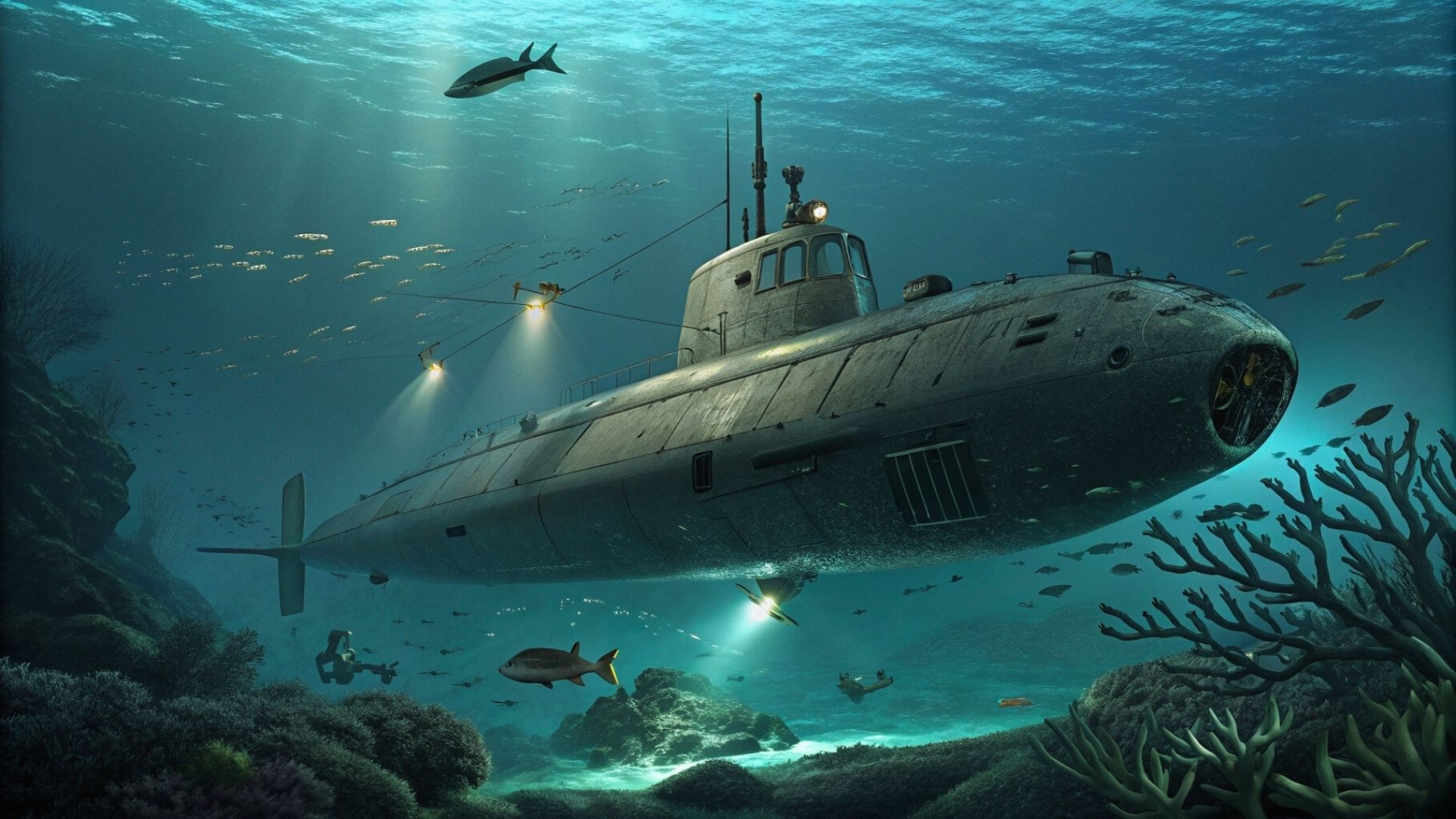

Fresh satellite imagery of China’s Bohai Shipyard in Huludao has provided one of the clearest views yet of a new nuclear-powered attack submarine widely believed to be part of the next-generation Type-095 class. Beijing, however, has not officially confirmed the submarine’s designation, according to the Times of India.
The imagery, captured by commercial satellite operator Vantor on September 18, shows the submarine under construction at the strategically important northern shipyard, a key centre for China’s nuclear submarine production.
The latest images have drawn considerable attention from naval analysts because they provide a clearer view of the submarine’s stern and appear to reveal several advanced design features that could enhance its stealth, manoeuvrability and overall combat performance.
One of the most notable features is an apparent pump-jet propulsion system. Unlike conventional submarine propellers, which remain exposed at the stern, a pump-jet system encloses the propulsor within a specially designed shroud.
Pump-jet propulsion is generally associated with reduced acoustic signatures, improved efficiency at higher underwater speeds and enhanced survivability. For nuclear-powered attack submarines, acoustic stealth is particularly important because lower noise levels can make detection and tracking more difficult for hostile submarines, surface combatants and maritime patrol aircraft.
The imagery therefore appears to indicate that China is incorporating propulsion technologies traditionally associated with some of the world’s most advanced submarine fleets.
X-Shaped Stern Highlights New Design Approach
The submarine also appears to incorporate an X-shaped stern control configuration, representing a departure from the conventional cruciform arrangement seen on many earlier Chinese nuclear-powered submarines.
An X-tail can provide improved underwater control and manoeuvrability, particularly during complex manoeuvres. It may also offer potential hydrodynamic and acoustic advantages.
The apparent combination of pump-jet propulsion and an X-shaped stern suggests that Chinese naval engineers are placing increasing emphasis on underwater stealth and handling performance. Similar features observed on other recent Chinese submarine projects could also indicate the adoption of common design approaches across different submarine programs.
Satellite imagery has additionally generated speculation about the submarine’s potential weapons configuration. Analysts have identified unusual structural features along parts of the hull that could potentially provide additional payload capacity.
Some observers have suggested that the design might eventually accommodate advanced missile-launch capabilities. However, there is currently no definitive public confirmation of such a configuration.
The imagery has also highlighted several unexplained openings near the submarine’s forward section. Their exact purpose remains uncertain and could relate to sonar equipment, specialised systems or future payload configurations.
China Accelerates Nuclear Submarine Development
China’s submarine modernization forms part of a broader naval expansion that has accelerated considerably over the past decade. The People’s Liberation Army Navy has expanded both its conventional and nuclear-powered submarine fleets while simultaneously increasing surface-ship production.
The suspected Type-095 is expected to succeed the Type-093 family of nuclear-powered attack submarines. If confirmed, the new class could represent a significant step forward in China’s nuclear attack-submarine capabilities, particularly in terms of acoustic stealth, propulsion and underwater manoeuvrability.
International defence analysts have previously suggested that the Type-095 could reduce the technological gap between Chinese nuclear-powered attack submarines and more advanced Western designs. Its development could also have wider implications for the evolving undersea security environment across the Indo-Pacific and South Asia.
Pakistan Expands Its Submarine Fleet
Pakistan is simultaneously strengthening its submarine capabilities through an eight-boat Hangor-class acquisition program based on China’s Type-039A submarine design. Four submarines are being constructed in China, while the remaining four are planned for construction in Karachi.
The program is expected to be completed by 2028. The Hangor-class submarines will feature air-independent propulsion (AIP), allowing conventional submarines to remain submerged for substantially longer periods without surfacing or frequently snorkeling to recharge their batteries.
Extended submerged endurance can make conventional submarines more difficult to detect and provides greater operational flexibility against maritime patrol aircraft, unmanned systems and surface combatants.
Once all eight boats enter service, Pakistan’s submarine fleet is expected to reach 11 vessels. Nine of these submarines are projected to feature AIP capability, representing an increase in underwater endurance across the fleet.
India Pursues Submarine Modernization
India, meanwhile, continues to modernize its submarine fleet through multiple parallel programs. The Indian Navy operates conventional submarines from the Kalvari, Sindhughosh and Shishumar classes, alongside its strategic nuclear-powered submarine force.
India is also working to extend the submerged endurance of its Kalvari-class submarines through the integration of a DRDO-developed indigenous AIP system. The technology is intended to allow the submarines to remain underwater for longer periods and improve their survivability and operational flexibility.
However, delays affecting several submarine acquisition and construction programs have constrained the pace of fleet expansion. India’s 1998 submarine construction plan had envisioned a fleet of 24 conventional submarines by 2030, but implementation has remained substantially behind the original timeline.
Only a limited number of new conventional submarines have entered service under the modernization effort, while several older boats have been retired.
P-75I and Future Indian Submarine Programs
India’s strategically important P-75I submarine program has nevertheless advanced. The project seeks to acquire a new generation of conventional submarines, with the program involving Indian shipbuilder Mazagon Dock Shipbuilders Limited and Germany’s ThyssenKrupp Marine Systems.
The program is intended to introduce advanced conventional submarine capabilities, although operational deliveries remain several years away.
India is also pursuing Project-76, which is expected to complement P-75I by supporting the development of indigenous conventional submarine capabilities. At the same time, Project-77 is associated with India’s efforts to develop nuclear-powered attack submarines, a capability considered important for long-term blue-water naval operations and undersea deterrence.
India has additionally pursued the leasing of another Russian nuclear-powered submarine as an interim measure while indigenous submarine programs progress. However, these initiatives remain at different stages of development and are unlikely to provide immediate additions to the operational fleet.
Asia’s Undersea Competition Intensifies
The latest imagery from Bohai Shipyard highlights the pace of China’s submarine technology development while illustrating the broader evolution of undersea capabilities across Asia.
China is advancing next-generation nuclear-powered submarines featuring potentially sophisticated propulsion and control technologies. Pakistan is expanding its conventional submarine fleet with AIP-equipped Hangor-class boats, while India is pursuing new conventional, nuclear-powered and indigenous propulsion programs.
The emerging regional environment is therefore placing increasing emphasis on stealth, submerged endurance, acoustic performance, advanced propulsion and underwater manoeuvrability. These technologies are likely to remain central to submarine development as Asian navies seek to strengthen their ability to operate and survive in increasingly contested maritime environments.