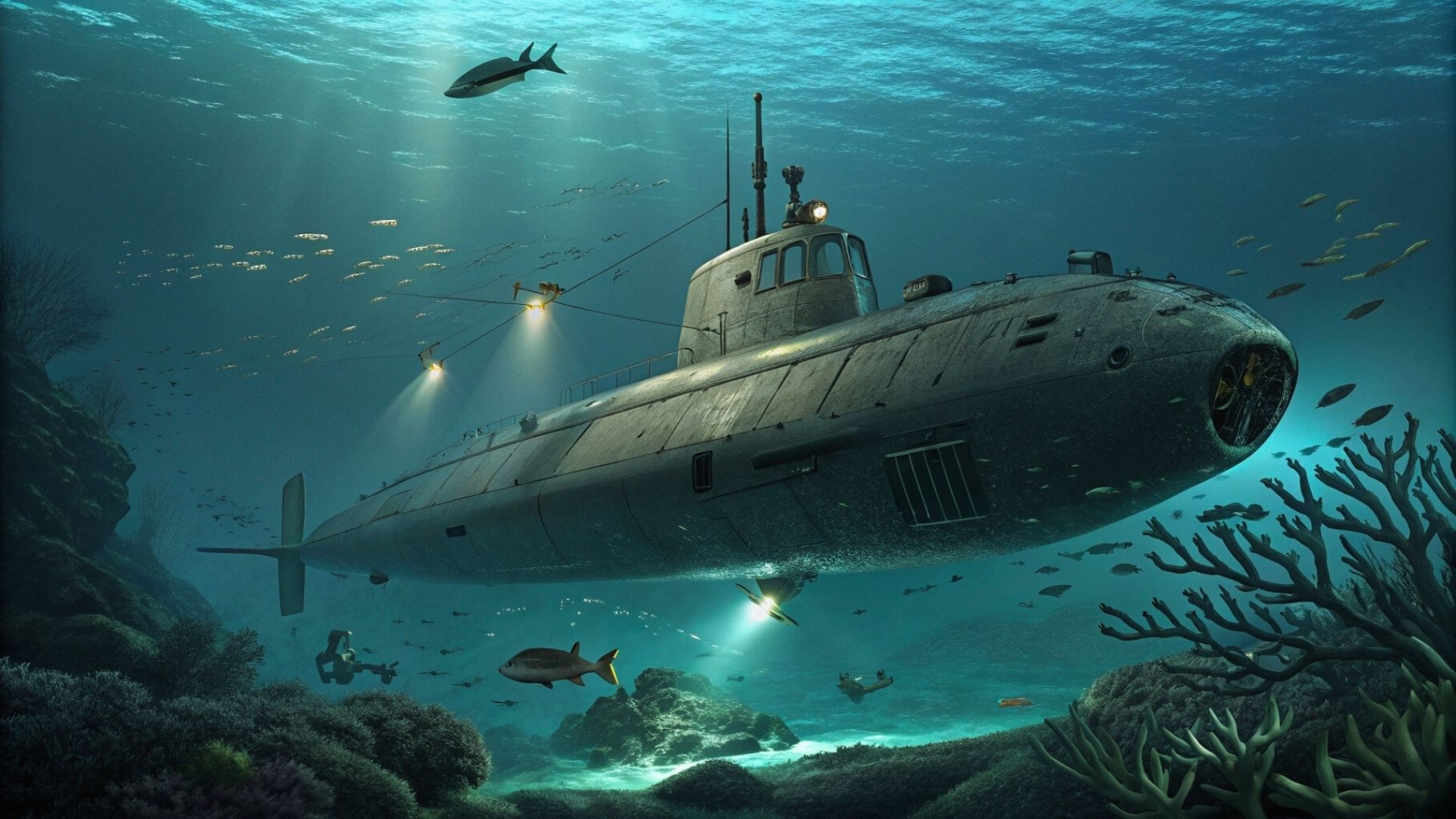
Project-76, the Indian Navy’s planned indigenous conventional submarine programme, is emerging as the focal point of a growing industrial contest between Mazagon Dock Shipbuilders Limited (MDL) and Larsen & Toubro (L&T), with both companies advancing separate approaches to the development of India’s future conventional attack submarine fleet.
Sources indicate that MDL has initiated work on a domestically designed 3,000-ton-class submarine concept that builds upon the technological and operational experience gained through the Kalvari-class programme. Project-76 is expected to become India’s first fully indigenous conventional submarine development effort, representing a significant departure from earlier programmes that relied heavily on foreign partners, including the German-origin Shishumar-class, the French-derived Kalvari-class, and the upcoming Project-751 initiative.
The new programme seeks to create a submarine optimized for future underwater warfare, featuring enhanced stealth characteristics, extended submerged endurance, indigenous combat systems, advanced sensors, and the ability to conduct land-attack and multi-domain missions.
To accelerate development, the Navy is reportedly examining the possibility of utilizing research conducted by L&T under the SOV-400 project. Although originally designed as a compact midget submarine intended for coastal and special operations roles, the SOV-400’s modular architecture and reportedly validated design framework have made it a potential foundation for a larger conventional submarine in the 2,500–3,000-ton category.
By evolving an existing design rather than developing a completely new platform, the Navy hopes to shorten development cycles and reduce programme risks. This approach has positioned L&T as a serious contender in the Project-76 landscape.
Over the past two decades, L&T has significantly expanded its expertise in submarine construction through its involvement in India’s nuclear submarine programmes. Its contributions to the Arihant-class and S4-class projects have provided extensive experience in pressure hull fabrication, complex naval manufacturing, and strategic defence production.
The company has also pursued opportunities in the conventional submarine segment, most notably through its partnership with Spain’s Navantia during the Project-751 competition. However, the Navy ultimately selected the MDL-TKMS proposal based on a design derived from the German U-212CD submarine.
Industry observers view Project-76 as L&T’s most significant opportunity to establish itself as a major player in conventional submarine construction. At the same time, MDL is reportedly advancing a next-generation concept often referred to as the “Super Kalvari,” which would build on the proven Kalvari-class architecture while incorporating larger displacement, improved endurance, reduced acoustic signatures, advanced combat systems, and greater indigenous content.
MDL’s decades of experience in submarine production, integration, and support provide it with a strong foundation for the programme. Its familiarity with pressure hull construction, acoustic management technologies, combat systems integration, and sustainment infrastructure could offer a competitive advantage as the Navy evaluates future options. The company is expected to present a detailed conceptual design around 2028, coinciding with the anticipated development timeline of the Navy-supported L&T concept.
As Project-76 gathers momentum, the competition between MDL and L&T is expected to drive technological innovation, strengthen domestic submarine design expertise, and reinforce India’s long-term objective of building a self-reliant underwater warfare capability supported by a robust indigenous industrial base.