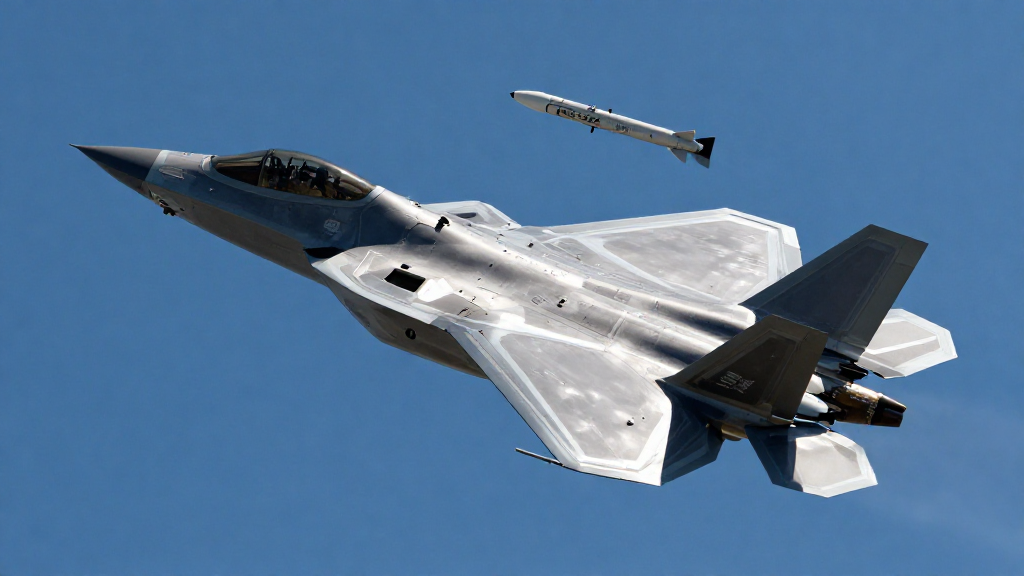

For the first time, the Indian Air Force (IAF) is set to conduct an exercise involving the US F-35A Lightning II stealth fighter. The fifth-generation aircraft will participate alongside French Rafale fighters, UAE F-16s and a broad mix of Indian combat and support aircraft during Tarang Shakti 2026.
The IAF will host the multinational air exercise at Air Force Station Jodhpur in Rajasthan from September 26 to October 12, positioning the event as one of Asia’s largest multinational air exercises.
India has extended formal invitations to 65 friendly foreign nations for the exercise. During a press conference, Vice Chief of the Air Staff Air Marshal Ashutosh Dixit stated that seven countries have confirmed participation with air assets, while another 32 nations will attend through observer delegations.
The foreign contingents will feature several advanced combat and support platforms. The United States is expected to deploy six F-35A Lightning II fighters supported by two KC-135 Stratotankers. France will participate with seven Rafale fighters, three A400M Atlas transport aircraft and two Multi-Role Tanker Transport aircraft.
The United Arab Emirates will deploy six F-16 fighter aircraft along with a Bombardier Global 6000 surveillance platform. Australia will contribute a C-130 Hercules transport aircraft, while Germany will send two A400M airlifters. From India’s neighbouring region, Bangladesh will participate with a C-130J Super Hercules, while Sri Lanka will deploy a King Air 350 aircraft.
Several countries will also attend as observers, including Cambodia, Egypt, Ethiopia, Japan, Indonesia, Italy, Laos, Malaysia, the Maldives, New Zealand, Nepal, Oman, the Philippines, Singapore and Vietnam.
Responding to questions about the absence of countries such as Russia, China, Israel and Saudi Arabia, despite the broad international participation, Air Marshal Dixit explained that the invitation framework was based on the specific objectives and structure of the exercise. The selection focused on opportunities to strengthen interoperability between India and the participating air forces.
Dixit said the invitation list was developed following extensive internal discussions and deliberations. He added that some countries were not invited because India already conducts separate bilateral air exercises with them.
The nearly three-week exercise is designed to enhance operational interoperability in the planning and execution of multinational air combat operations under realistic and contemporary battlespace conditions.
As the host nation, India will deploy a broad mix of indigenous and frontline platforms. The IAF contingent will include Rafale, Su-30MKI, LCA Tejas, Jaguar and MiG-29 fighters, along with Mi-35 attack helicopters, Mi-17 helicopters, airborne early warning and control systems, transport aircraft and air-to-air refuelling platforms.
Tarang Shakti was conceived to move beyond traditional bilateral air exercises toward more complex multinational engagements. During its inaugural edition in 2024, 11 foreign nations participated with air assets. The exercise involved 45 combat aircraft conducting 76 complex missions, generating 867 sorties and more than 1,180 flying hours.
According to Air Marshal Dixit, the IAF traditionally conducted exercises with individual strategic partners on a bilateral basis. The Tarang Shakti initiative introduced a different model by bringing multiple foreign air forces together, with the 2026 edition building on that approach.
During Tarang Shakti 2026, participating forces will be divided into two opposing formations designated REDFOR and BLUEFOR. Both sides will receive common mission briefings before conducting independent operational planning and tactical sorties, followed by detailed joint mission debriefings.
The exercise will cover a wide range of operational scenarios, including within-visual-range and beyond-visual-range air combat, large-force employment to protect high-value airborne assets, dynamic targeting, air mobility operations, combat search and rescue, and complex air-to-air and air-to-ground refuelling missions.
Air Marshal Dixit has described Tarang Shakti as an opportunity to identify operational gaps rather than simply demonstrate existing capabilities. Lessons from recent combat operations, including Operation Sindoor, are being incorporated into the exercise’s training framework.
Operation Sindoor, conducted in May 2025 following the Pahalgam terror attack, provided the IAF with operational experience involving intelligence-led precision strikes, multi-domain coordination, long-range surface-to-air missile engagements and counter-unmanned aerial system operations. Incorporating such experiences into multinational training allows participating forces to examine operational assumptions, refine tactics and develop greater mutual understanding.
The exercise will also place considerable emphasis on the human dimension of multinational air operations. Thousands of pilots, aircrew, technical personnel and maintenance teams from participating nations will work together in planning, mission execution and aircraft support, helping develop professional relationships and a deeper understanding of different operational procedures.
Alongside combat training, India will use Tarang Shakti 2026 to showcase its expanding domestic defence manufacturing capabilities. Indigenous combat aircraft, unmanned aerial systems, advanced weapons and sensor technologies will form part of India’s participation.
Air Marshal Dixit has emphasised that India’s drive toward greater domestic defence manufacturing and its international military partnerships can complement each other. A stronger indigenous industrial base can support India’s ability to participate in increasingly sophisticated multinational defence cooperation and air exercises.