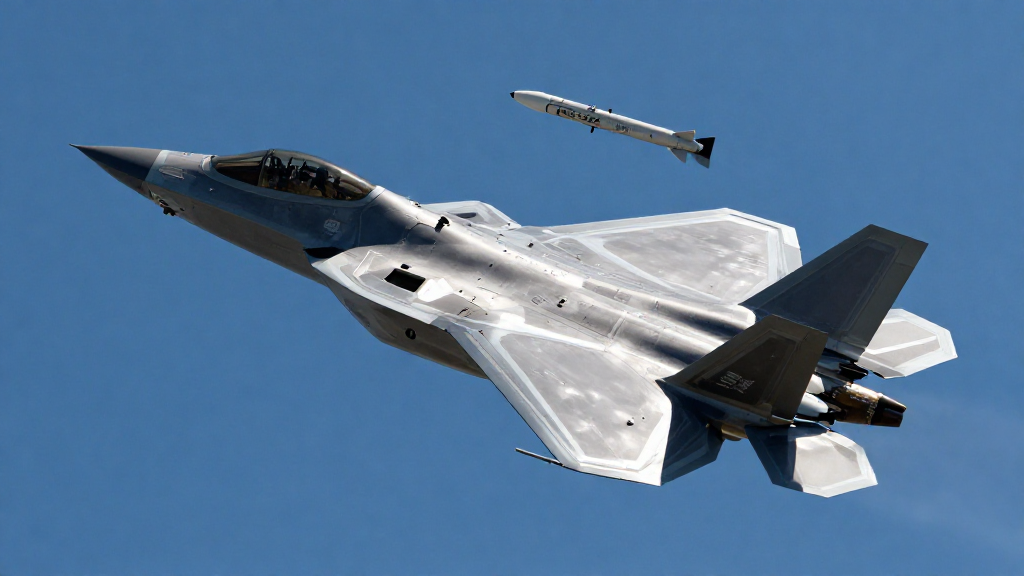
Analysis of the Su-57 fighter’s stealth features highlights differences between Russian and US approaches to fifth-generation aircraft design, according to Vietnamese media reports.
Both the Su-57 Felon and US fifth-generation fighters such as the F-22 Raptor and F-35 Lightning II incorporate low-observable technologies. However, the Su-57 is often distinguished by its pixelated camouflage pattern, featuring geometric shapes and multiple colour bands rather than the predominantly uniform grey finishes commonly seen on US stealth fighters.
Stealth performance begins with the aircraft’s aerodynamic configuration, airframe structure and radar-absorbent materials (RAM). These materials are designed to reduce the amount of radar energy reflected back toward the transmitting radar, contributing to a lower radar cross-section.
Some radar-absorbent materials use specialised compounds and structures to dissipate electromagnetic energy. Managing the thermal effects associated with these materials and other aircraft systems is also an important consideration because infrared sensors can detect heat generated by an aircraft.
Different Approaches to Visual Camouflage
US stealth fighters commonly feature grey-based finishes that support visual camouflage while complementing their low-observable characteristics. Their operational concepts place significant emphasis on detecting and engaging threats at extended ranges using advanced sensors and beyond-visual-range weapons.
The F-22 and F-35 are equipped with advanced active electronically scanned array (AESA) radars and sensor-fusion systems designed to provide pilots with a detailed picture of the battlespace. Their design philosophy places considerable emphasis on detecting threats, employing weapons from advantageous ranges and maintaining survivability.
The Su-57 uses a more visually distinctive pixelated camouflage scheme. Its geometric patterns can break up the aircraft’s visual outline and make identification more difficult under certain backgrounds and viewing conditions.
Some reports have also suggested that such patterns could complicate automated visual recognition by cameras and computer-vision systems used aboard drones or other surveillance platforms. However, the effectiveness of camouflage against modern AI-based tracking systems depends on factors including sensor resolution, viewing angle, lighting, background conditions and the algorithms being used.
Su-57 and Close-Range Combat
The differences extend beyond exterior appearance and reflect differing interpretations of future air combat.
A key assumption in some Russian analyses is that the proliferation of fifth-generation aircraft could reduce the advantage of long-range stealth when both sides operate low-observable platforms. In such scenarios, aircraft could potentially be required to operate closer to one another, increasing the importance of manoeuvrability, sensor awareness and close-range engagement capabilities.
The Su-57 combines low-observable features with aerodynamic design intended to provide high manoeuvrability. Its sensor suite, electronic-warfare capabilities and weapons are intended to support operations across different engagement ranges.
Its camouflage therefore represents one element of a broader survivability approach rather than a standalone stealth technology.
Contrasting Fighter Design Philosophies
The Su-57 and American fifth-generation fighters reflect different development priorities, although both are designed around low observability, advanced sensors and networked operations.
US aircraft such as the F-22 and F-35 place strong emphasis on stealth, sensor fusion, information dominance and beyond-visual-range engagements. The Su-57 combines low-observable design with an emphasis on manoeuvrability, sensor coverage and flexibility across different combat scenarios.
The Su-57’s pixelated camouflage can consequently be viewed as part of a broader approach to reducing visual detectability and complicating identification. Its contribution to overall survivability, however, depends on the aircraft’s complete combination of shaping, materials, sensors, electronic warfare, tactics and operational conditions rather than paint alone.