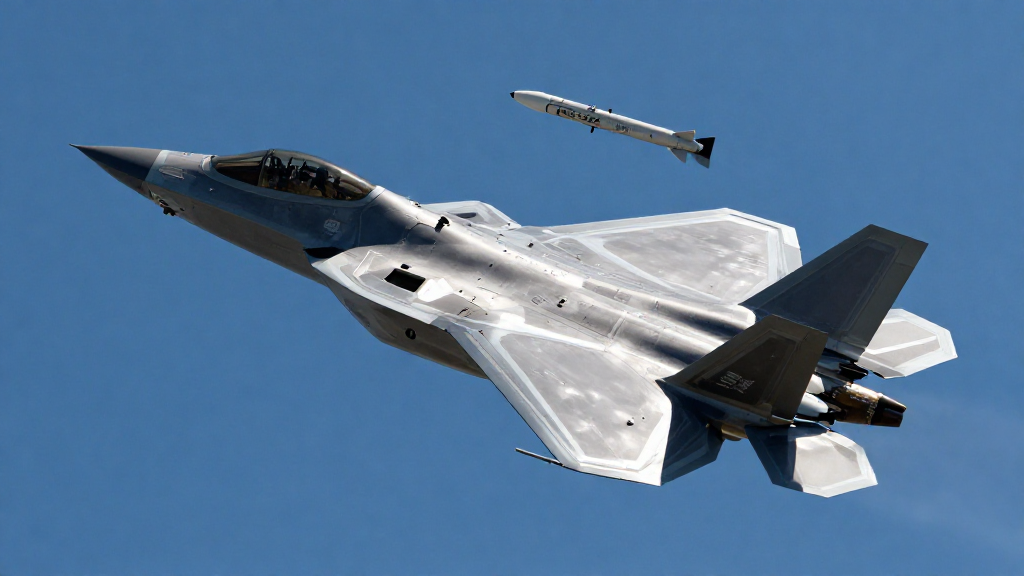

The Indian Air Force (IAF) is reportedly seeking a licence to manufacture the British MBDA ASRAAM as its standard close-combat air-to-air missile for a growing range of fighter aircraft, including the Tejas Mk1A, Su-30MKI and MiG-29UPG. However, while ASRAAM is emerging as the IAF’s preferred weapon for within-visual-range engagements, its relatively high cost could encourage the service to pursue a second, more affordable close-combat missile. One possible option could be a system derived from technologies developed for the DRDO’s existing VSHORADS programme rather than an entirely new missile.
### ASRAAM’s Expanding Role Across the IAF Fleet
ASRAAM’s introduction into Indian service dates back more than a decade. In 2013, the IAF selected the missile after evaluating competing systems including Israel’s Python, Germany’s Diehl IRIS-T and the US Raytheon AIM-9X Sidewinder. ASRAAM subsequently emerged as the winner of the Air Force’s New Generation Close Combat Missile (NGCCM) programme.
Since then, its planned integration has expanded significantly beyond the programme’s original requirements. ASRAAM has been selected for or integrated with platforms including the Tejas Mk1A, upgraded Jaguar fighters, Su-30MKI and, more recently, the MiG-29UPG. On several aircraft, the missile is progressively replacing the older Russian R-73 as part of the IAF’s broader effort to modernise its short-range air-to-air missile inventory.
ASRAAM provides several advantages over the systems it is replacing. While the R-73 has an engagement range of roughly 30 km, ASRAAM offers a range of approximately 50 km, along with an advanced imaging-infrared seeker, improved manoeuvrability and high off-boresight targeting capability. This enables the missile to engage targets at significant angles away from the launching aircraft’s flight path, providing an important advantage during close-range aerial combat.
The programme also supports India’s push for greater defence self-reliance. MBDA and Bharat Dynamics Limited (BDL) have established a licensing arrangement to support final assembly, integration and testing of ASRAAM at BDL’s facility in Hyderabad. This arrangement enables India to undertake local assembly, testing and maintenance while reducing dependence on completely imported missiles.
Despite these advantages, ASRAAM remains a sophisticated and relatively expensive Western weapon. Even with local production, its advanced seeker, high off-boresight capability and overall performance place it in the high-end category of air-to-air missiles. This becomes an important consideration for the IAF because its fighter fleet is both large and expanding, encompassing aircraft such as the Tejas Mk1A and Mk2, Su-30MKI, Rafale and MiG-29UPG, with the future Advanced Medium Combat Aircraft (AMCA) also expected to join the fleet.
Equipping every fighter with the most expensive available close-combat missile for every operational and training sortie could therefore impose a significant financial burden. A complementary, lower-cost missile could provide an economical alternative for training, routine operations and engagements where the full capabilities of ASRAAM are not required.
This approach reflects a broader trend in India’s weapons modernisation strategy, where different levels of capability and cost are increasingly being considered for different operational scenarios. Similar thinking has emerged in areas such as counter-drone systems and low-cost interceptors, where using an expensive weapon against a relatively inexpensive target can create an unfavourable cost imbalance.
### VSHORADS as a Potential Technology Base
Against this backdrop, DRDO’s Very Short Range Air Defence System (VSHORADS) could offer a potentially useful technological foundation for a future low-cost air-to-air missile. It would not serve as a direct replacement for ASRAAM, but selected technologies from the system could potentially be adapted into a dedicated close-combat missile designed for fighter aircraft.
VSHORADS is a fourth-generation, man-portable air-defence system developed by DRDO’s Research Centre Imarat. The missile was designed to counter low-altitude aerial threats such as drones, helicopters and aircraft at short ranges. Its architecture incorporates a miniaturised reaction-control system, integrated avionics and a dual-waveband imaging-infrared seeker.
The system’s technologies have undergone multiple flight-test campaigns at the Integrated Test Range in Chandipur, where the missile has demonstrated its ability to engage high-speed aerial targets under different test conditions. This existing technology base could potentially reduce the risks and development time associated with creating a completely new close-combat missile.
VSHORADS is relatively compact, weighing around 20.5 kg, measuring approximately 2 metres in length and having a diameter of about 90 mm. It uses a dual-thrust solid rocket motor and can reach speeds of up to around Mach 1.5, with an effective engagement range generally reported at approximately 6–8 km depending on the variant.
Although these characteristics are optimised for a man-portable ground-launched system rather than a fighter-launched weapon, the missile’s compact dimensions, established seeker technology and emphasis on cost-effective mass production could make its technology relevant to a future airborne application.
An air-launched derivative would, however, require substantial engineering changes. The airframe, propulsion characteristics, aerodynamic control surfaces, launch interface and other components would need to be redesigned to account for aircraft carriage and release conditions. The guidance and seeker technologies could potentially provide a starting point, rather than the existing VSHORADS missile being directly adapted for fighter use.
Developing a lower-cost close-combat missile around technologies already demonstrated through VSHORADS could allow DRDO and Indian industry to leverage existing knowledge in infrared sensing, guidance, control systems and manufacturing. This could reduce some of the technical and financial risks associated with starting an entirely new missile programme.
The VSHORADS programme’s original emphasis on affordability and mass production could also support the development of an economical air-to-air weapon. If sufficient commonality were achieved, the resulting missile could potentially be produced at a lower unit cost than a completely new high-end design.
### Toward a Tiered Air-to-Air Missile Arsenal
The potential development of a lower-cost close-combat missile illustrates a broader shift in India’s approach to combat-aircraft armament. Rather than relying on a single premium weapon for every mission, the IAF and DRDO appear to be moving toward a more diversified and tiered weapons inventory.
Under such a model, ASRAAM could serve as the high-end close-combat missile for demanding operational scenarios, while a less expensive, indigenously developed weapon could be used for training, routine missions and situations where maximum missile capability is not essential.
This approach could help balance operational effectiveness with procurement costs as India’s fighter fleet continues to expand. It would also support greater domestic participation in air-to-air missile production and technology development.
The concept follows the same cost-efficiency logic being explored elsewhere in India’s air-defence modernisation efforts: expensive weapons should be reserved for targets and situations that justify their cost, while lower-cost systems can handle higher-volume or less demanding engagements. If DRDO can successfully translate relevant VSHORADS technologies into an effective fighter-launched missile, the resulting system could complement ASRAAM and provide the IAF with a more flexible and economically sustainable close-combat weapons architecture.