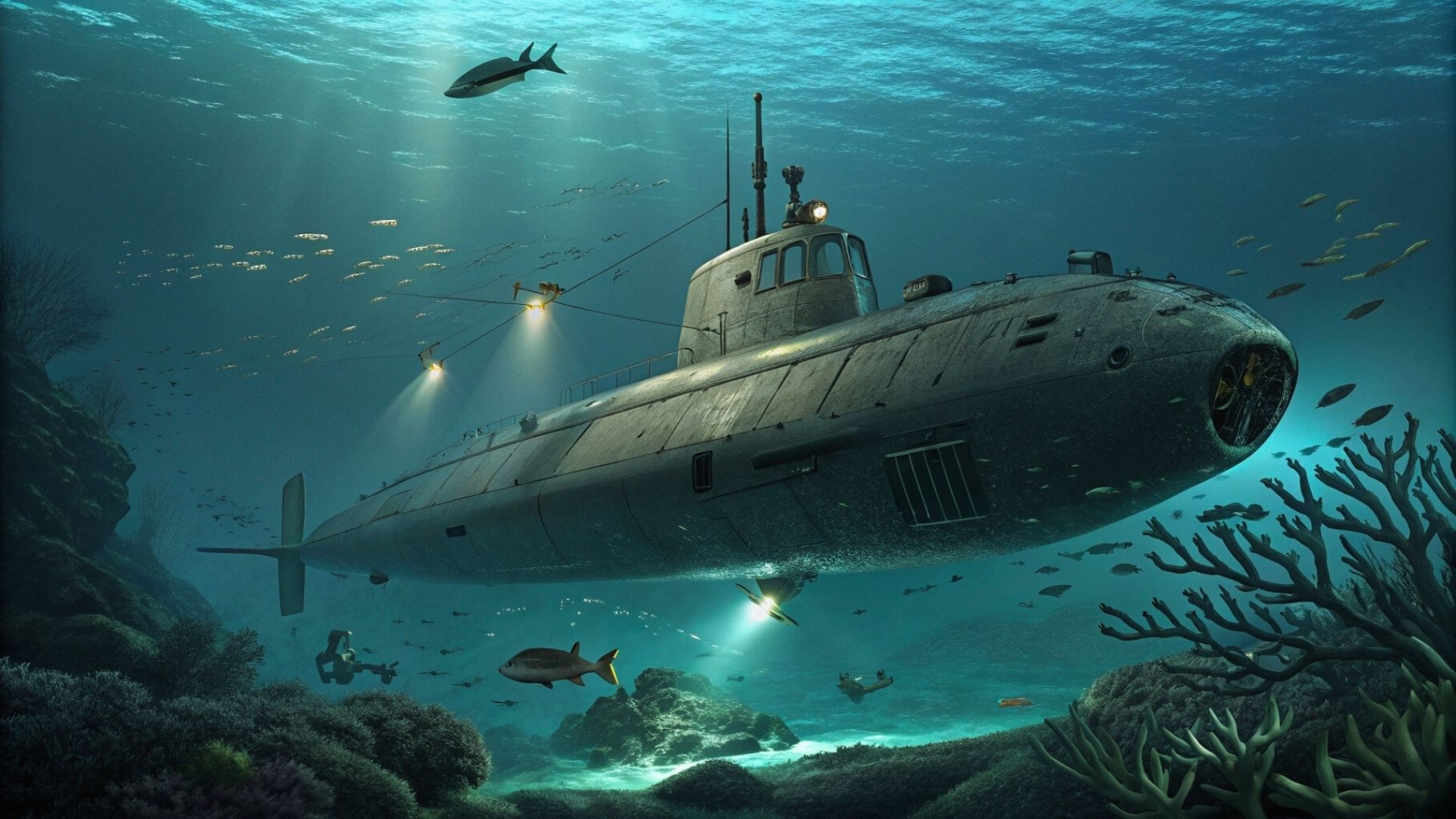
The world’s oceans are becoming increasingly contested, particularly across the Indo-Pacific, where regional navies are expanding their fleets and underwater threats continue to evolve. In response to this changing maritime environment, Japan has developed one of its most advanced conventional submarines: the Taigei class.
Featuring improved acoustic stealth, modern sensor systems and lithium-ion battery technology, these submarines represent an important advancement in Japan’s undersea warfare capabilities. Their design reflects the country’s focus on strengthening maritime deterrence and protecting its strategic interests across the region.
What Is the Taigei-Class Submarine?
The Taigei class is the Japan Maritime Self-Defense Force’s (JMSDF) latest generation of diesel-electric attack submarines, developed as the successor to the Soryu class.
The submarines retain the stealth and operational flexibility associated with modern conventional designs while introducing improvements in propulsion, sonar, combat management and underwater endurance.
A defining feature is the use of high-capacity lithium-ion batteries, which store more energy and recharge faster than traditional lead-acid batteries. This technology allows the submarines to remain submerged for longer periods under suitable operating conditions, reducing the frequency of snorkeling and helping limit their exposure to detection.
The Taigei class plays an important role in Japan’s maritime defence strategy, supporting anti-submarine warfare, anti-surface operations, intelligence collection and the protection of vital sea lines of communication in the East China Sea and western Pacific.
Development of the Taigei Class
Japan’s development of the Taigei class forms part of a broader effort to modernise its conventional submarine fleet through advances in energy storage, acoustic performance and underwater operations.
The programme evolved from experience gained with the Soryu-class submarines, several of which used air-independent propulsion (AIP) to extend submerged operations without relying solely on diesel-electric propulsion.
As lithium-ion battery technology matured, Japan adopted it as an alternative approach to improving underwater performance. The technology offers faster recharging, greater energy storage and operational flexibility, although its advantages depend on mission requirements and operating conditions.
The final two Soryu-class submarines were equipped with lithium-ion batteries, providing valuable experience before the technology became a central feature of the Taigei design.
Construction of the lead vessel, JS Taigei, began in 2018, with Mitsubishi Heavy Industries and Kawasaki Heavy Industries contributing to the submarine programme.
The vessel entered service in 2022 and was redesignated as a test submarine in 2024 to support the evaluation of future undersea technologies. Meanwhile, additional boats have continued to expand Japan’s next-generation submarine fleet.
Taigei-Class Submarine Variants
The Taigei family consists primarily of submarines built to a common design, rather than separate variants dedicated to specialised combat roles.
The class includes the following vessels:
JS Taigei (SS-513): The lead submarine, commissioned in 2022 and redesignated SSE-6201 in 2024 for technology testing.
JS Hakugei (SS-514): The second submarine in the class.
JS Jingei (SS-515): An additional production submarine.
JS Raigei (SS-516): Another vessel expanding the JMSDF fleet.
JS Chogei (SS-517): A subsequent submarine in the programme.
Further vessels have been planned, approved or developed as Japan continues modernising its underwater capabilities.
How Does the Taigei-Class Submarine Work?
The Taigei class combines quiet propulsion, advanced sensors and integrated combat systems to detect, track and engage potential threats while minimising the risk of being detected.
Lithium-Ion Battery Propulsion
One of the submarine’s most significant innovations is its large-capacity lithium-ion battery system.
Compared with conventional lead-acid batteries, lithium-ion technology offers greater energy density and faster charging. These advantages can support longer submerged operations and improved underwater performance.
The system also allows the submarine to operate without a separate AIP installation, providing a different balance between endurance, speed, complexity and maintenance. However, the submarine still relies on diesel generators to recharge its batteries and must periodically snorkel or surface, depending on operational requirements.
Advanced Sonar and Combat Management
The Taigei class incorporates an upgraded sonar suite designed to improve underwater detection and situational awareness. Its sensor configuration includes bow-mounted sonar, flank-array sensors and a towed-array system for detecting acoustic signatures.
An advanced combat management system processes information from onboard sensors, helping the crew identify contacts, maintain situational awareness and coordinate responses to potential threats.
Together, these systems strengthen the submarine’s ability to conduct surveillance and operate in complex underwater environments.
Enhanced Acoustic Stealth
Reducing underwater noise is essential for avoiding detection by hostile submarines and surface vessels.
The Taigei incorporates hull-design improvements, sound insulation, floating deck structures and acoustic-reduction measures intended to minimise machinery and structural noise.
Its distinctive X-shaped stern control surfaces also provide enhanced manoeuvrability and control, including in confined or relatively shallow waters.
Key Strengths of the Taige Class
The submarine offers several advantages over earlier conventional designs:
Extended submerged operations: Lithium-ion batteries improve energy storage and charging performance.
Improved acoustic stealth: Noise-reduction measures help limit detection.
Advanced underwater surveillance: Modern sonar and combat systems improve target detection and tracking.
Enhanced manoeuvrability: The X-shaped stern configuration supports effective underwater control.
Modern onboard systems: Improved automation and integrated digital systems can help manage crew workload.
Improved crew facilities: The design incorporates accommodations intended to support mixed-gender crews, including dedicated facilities for female personnel.
These features make the Taigei class a significant component of Japan’s evolving undersea warfare capabilities.
Limitations of the Taigei Class
Despite its advanced technology, the Taigei class has several limitations.
Conventional propulsion: Unlike nuclear-powered attack submarines operated by countries such as the United States, the United Kingdom and France, the Taigei must periodically use its diesel generators to recharge its batteries. Lithium-ion technology improves endurance but cannot provide the sustained submerged endurance of nuclear propulsion.
High procurement costs: Advanced batteries, sonar equipment and acoustic-reduction technologies contribute to substantial acquisition costs. Publicly reported estimates place the cost of an individual submarine at approximately 70 billion yen, although actual costs vary by vessel and procurement year.
Limited export availability: Japan has gradually expanded the scope of its defence equipment transfers, but the Taigei class has not become a widely exported submarine design. Sensitive technologies, including its battery systems and acoustic-signature reduction measures, may complicate potential overseas sales.
Operational constraints: Like other conventional submarines, the Taigei’s endurance and operating profile depend on battery capacity, mission requirements, speed and the need to recharge.
Global Deployment and Strategic Importance
The Taigei class currently serves with the Japan Maritime Self-Defense Force and has not entered widespread international service.
Its principal missions include anti-submarine warfare, anti-surface warfare, maritime surveillance, intelligence gathering, deterrence patrols and protecting Japan’s vital maritime routes.
These capabilities are particularly relevant in the East China Sea, the Philippine Sea and the wider Indo-Pacific, where submarine operations play an increasingly important role in maritime security.
Although the class has not been widely exported, Japan’s adoption of lithium-ion batteries has attracted international attention. Other navies and submarine designers are monitoring the technology’s operational benefits and the lessons emerging from its use.
Future Outlook
The Taigei class represents a major step forward in conventional submarine development and provides a technological foundation for Japan’s future undersea programmes.
Experience gained from its battery technology, acoustic-reduction measures and digital combat systems is expected to inform subsequent submarine designs and improvements to the existing fleet.
As China expands its naval capabilities and competition intensifies across the Indo-Pacific, Japan’s investment in advanced conventional submarines is likely to remain an important element of its maritime defence strategy.
Although nuclear-powered submarines retain advantages in sustained underwater endurance and long-distance operations, the Taigei demonstrates how advances in conventional propulsion and onboard technology can deliver highly capable platforms without nuclear reactors.
Ultimately, the Taige class highlights Japan’s approach to modern undersea warfare: combining stealth, sophisticated sensors, improved energy storage and operational flexibility to strengthen its maritime deterrence in an increasingly competitive Indo-Pacific.