EndureAir Systems has introduced VAHAK-6, an innovative multi-UAV mothership concept developed with Bharat Electronics Limited (BEL). The new system combines the company’s SABAL 20 unmanned helicopter with up to six smaller UAVs, creating an airborne platform capable of transporting, deploying, and coordinating multiple drones near the mission area.
The concept represents a shift from conventional drone operations, where individual micro-UAVs are launched directly from the ground and must use part of their limited endurance to reach the target. VAHAK-6 instead uses the SABAL 20 as an aerial carrier, enabling smaller drones to be released closer to the area of operation.
The system is designed to deploy EndureAir’s ALAKH micro-UAVs, allowing them to dedicate more of their battery endurance to surveillance, reconnaissance, or other mission tasks.
At the center of the architecture is the SABAL platform, a lightweight tandem-rotor VTOL unmanned helicopter equipped with variable-speed electric propulsion. The platform has been designed for logistics, surveillance, and reconnaissance missions and supports beyond-visual-line-of-sight operations and modular payload configurations.
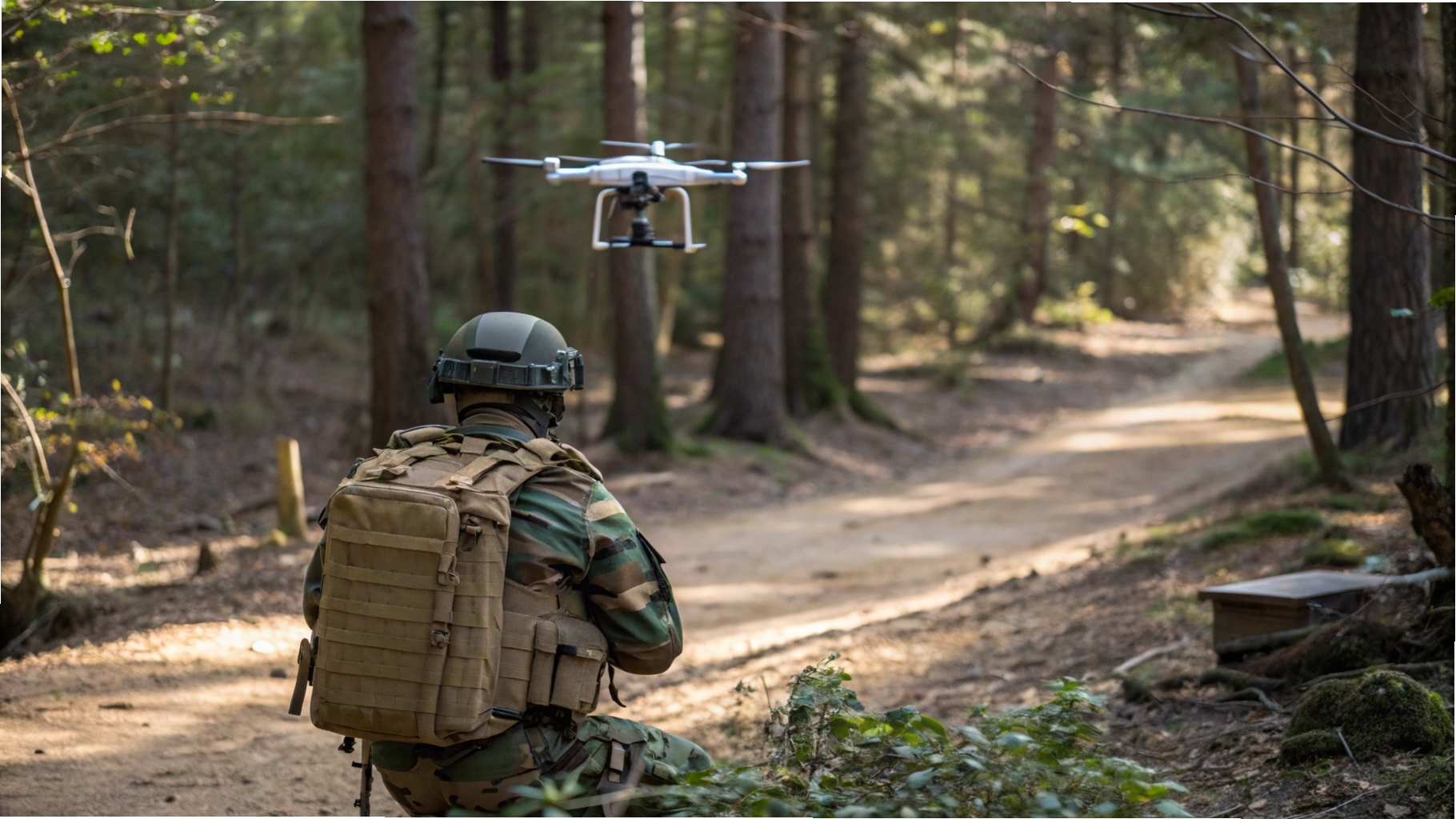
The smaller ALAKH UAV complements the SABAL 20. EndureAir describes ALAKH as a micro-FPV drone weighing approximately 250 to 800 grams, with the ability to carry payloads of up to 400 grams. Its ability to operate in confined spaces and navigate without GPS could make it useful for close-range reconnaissance and missions in complex environments.
Together, the two platforms form a distributed aerial network. The SABAL 20 transports the smaller drones while also acting as an airborne command and control node. After deployment, the UAVs can conduct individual missions or operate together as a coordinated group.
One of the key advantages of this approach is the potential to increase the usable range and endurance of micro-UAVs. By carrying them closer to the target area, the mothership reduces the distance the smaller drones must travel independently, allowing more of their available power to be dedicated to mission execution.
The VAHAK-6 concept could also enable mixed drone teams. EndureAir has indicated that the system can combine surveillance-focused ALAKH UAVs with expendable strike variants, potentially supporting Search, Detect, and Destroy operations from a single airborne platform.
The system is intended to operate in challenging environments where electronic warfare, communication disruption, and GPS denial may affect conventional unmanned systems. Its actual performance in such conditions will depend on the maturity of its autonomous capabilities, navigation systems, and communication links.
The use of a compact VTOL mothership could provide additional operational flexibility, particularly in areas where deploying or basing larger fixed-wing aircraft is difficult. This could make the concept suitable for a variety of military environments.
Potential applications for the Indian armed forces include border surveillance, battlefield reconnaissance, urban operations, and distributed sensing. A single mothership could approach an area and subsequently deploy multiple UAVs in different directions, creating a wider network of sensors and observation points.
The system could also offer greater mission resilience. Since multiple UAVs can be carried and deployed, the loss of an individual drone would not necessarily result in mission failure. Different UAVs could also be equipped with specialized payloads to perform separate reconnaissance, surveillance, or strike-related tasks.
VAHAK-6 demonstrates an approach focused on building an interconnected unmanned ecosystem rather than simply increasing the size of individual drones. By combining transportation, command, deployment, and specialized autonomous UAV operations, the system could represent a new direction for distributed unmanned aerial operations in India.