As air combat evolves toward longer ranges and more contested environments, the need for advanced air-to-air weapons has become critical. The AIM-260 Joint Advanced Tactical Missile (JATM) is the United States’ answer to this challenge, designed to extend engagement distances and maintain superiority against emerging high-end threats.
The AIM-260, developed by Lockheed Martin, is a next-generation beyond-visual-range missile intended to augment and gradually replace the AIM-120 AMRAAM. It reflects a strategic shift toward greater standoff capability, improved survivability, and dominance in scenarios involving peer adversaries equipped with advanced aircraft and electronic warfare systems.
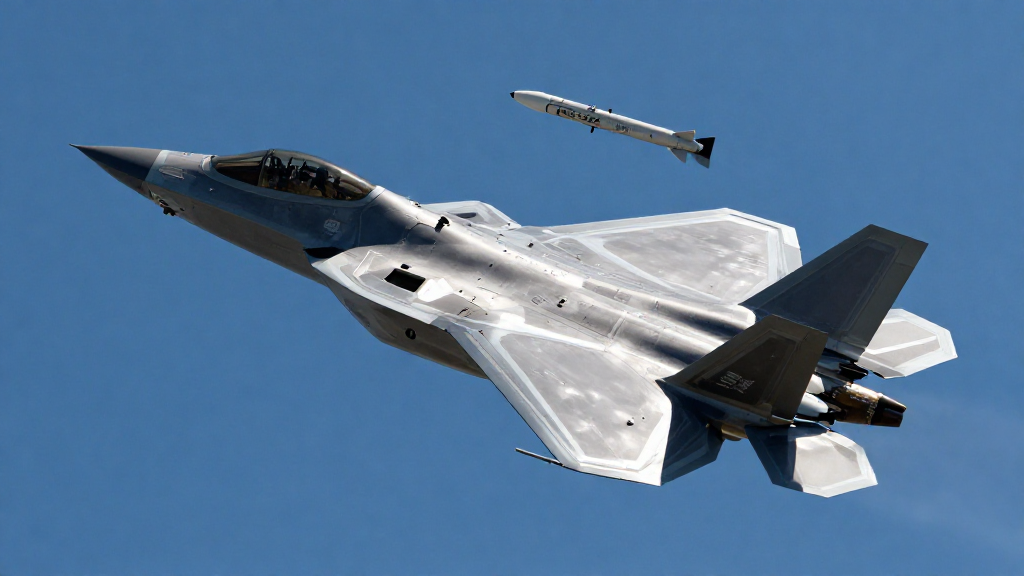
Although detailed specifications remain classified, the missile is expected to offer significantly greater range than existing systems, allowing US fighters to engage threats earlier while remaining outside hostile engagement zones. Importantly, it is designed to fit within the internal weapon bays of stealth aircraft such as the F-22 and F-35, preserving their radar-evading profiles.
Key anticipated features include a highly capable seeker designed for electronic warfare conditions, a two-way datalink enabling real-time guidance updates, strong resistance to jamming and countermeasures, and an efficient propulsion system tailored for long-range engagements. The emphasis is on adaptability, network integration, and reliability rather than sheer speed.
The missile will be integrated across US Air Force and Navy platforms, with the F-22 expected to lead operational deployment. It will initially complement the AIM-120, which will continue to serve in less demanding roles while the AIM-260 is employed against advanced threats.
The program was driven by the growing capabilities of rival systems, particularly China’s PL-15, which narrowed the performance gap in long-range air combat. In response, the AIM-260 is designed to restore the US advantage by extending engagement envelopes and improving first-strike capability.
In operational terms, the missile enhances the ability to detect, track, and engage targets at greater distances, often using data from external sensors rather than relying solely on the launching aircraft. This aligns with modern distributed warfare concepts and improves survivability in contested environments such as the Indo-Pacific.
Maintained under a high level of secrecy, the AIM-260 is expected to enter service later this decade. By integrating advanced guidance, extended range, and compatibility with next-generation combat systems, it is set to play a key role in ensuring continued US and allied air dominance.